Choosing the right duck egg incubator can make a big difference in hatch rates, especially when you need steady heat, consistent humidity, and dependable egg turning.
Below, we’ve rounded up 10 buyer-friendly options for beginners and experienced hatchers alike, with a focus on practical features that matter most during incubation.
Best 10 Duck Egg Incubator Picks for 2026
Precision Control HatchPro
APDOE 12-Egg Incubator with Candler

- Real-time temperature and humidity display
- Auto turns eggs every 2 hours
- Built-in candler and 360° clear dome
Best For: Beginners and small hatches that need simple monitoring
Stable Monitoring Pick
- Stable airflow with circulating fan
- Humidity display and built-in candler
- Auto-stop turner before hatch
Best For: Small hatches and users who want core features built in
High-Capacity Smart Hatch
Sailnovo 70 Egg Smart Incubator
- Up to 70 eggs with adjustable trays
- Auto turning plus built-in candler
- LED alerts for temperature and humidity
Best For: Large batches, school use, and mixed poultry hatching
Beginner-Friendly Basic Hatch

- Auto turns eggs every 2 hours
- Self-regulating humidity with one bottle
- Clear lid and real-time temperature display
Best For: Beginners who want a simple small-batch setup
Premium 18-Egg Versatility
APDOE 18-Egg Incubator for Ducks and More
- Dedicated tray fits up to 8 duck eggs.
- Auto turning offers 1h, 2h, or 3h intervals.
- External bottle supports easier humidity control.
Best For: Users hatching duck eggs and mixed poultry batches
Large Batch Control
56-Egg Incubator with Smart Alerts
- Holds up to 56 eggs for larger batches.
- Auto turning stops 3 days before hatching.
- Smart alarm tracks temperature and humidity changes.
Best For: Small farms, schools, and labs hatching multiple duck eggs
Compact Smart Pick
18-Egg Incubator with Auto Turning

- Supports 18 eggs, including duck eggs.
- Turning intervals can be set to 60, 120, or 180 minutes.
- LED candling and 360° dome simplify checking.
Best For: Home users and classrooms with small duck egg batches
Precision 12-Egg Controller
Compact 12-Egg Duck Egg Incubator

- 12-egg capacity for duck eggs and other poultry
- Digital display tracks temperature and humidity
- Auto turning plus built-in candling and airflow
Best For: Small-batch hatchers who want compact, hands-off control
Hands-Off Humidity Pick
Sailnovo 12-Egg Duck Egg Incubator

- Automatic humidity control reduces lid opening
- Built-in candler and 360° viewing aid monitoring
- Auto-turning stops 4 days before hatch
Best For: Beginners and schools that want simple humidity control
Easy-Clean Monitoring Choice
Grey 12-Egg Duck Egg Incubator

- External water fill supports stable humidity
- 360° transparent view and built-in candling
- Auto turning with selectable turn intervals
Best For: Buyers who want easy cleaning and low-fuss monitoring
Precision Control HatchPro – APDOE 12-Egg Incubator with Candler
If you want a duck egg incubator with more hands-off control, this APDOE model is built around temperature and humidity monitoring, automatic turning, and easy viewing. It suits users who want a compact 12-egg setup with features that reduce daily checking and make it easier to track development.
Best For: Beginners, classrooms, and small home hatches that benefit from automated monitoring and simple operation.
Pros:
- Real-time temperature and humidity display for quick monitoring.
- Automatic egg turning every 2 hours, with the tray removable for the final 3 days.
- 2-in-1 humidity control system with dual external water bottles and an adjustable air vent.
- 360° transparent dome plus built-in egg candler for easy observation.
Cons:
- Holds only 12 eggs, so it is not intended for larger batches.
- Do not put parts in the dishwasher, so cleaning still requires some care.
Overall, this is a practical duck egg incubator for users who want visibility, automation, and fewer interruptions during incubation. Its compact size and built-in tools make it especially convenient for first-time hatchers.
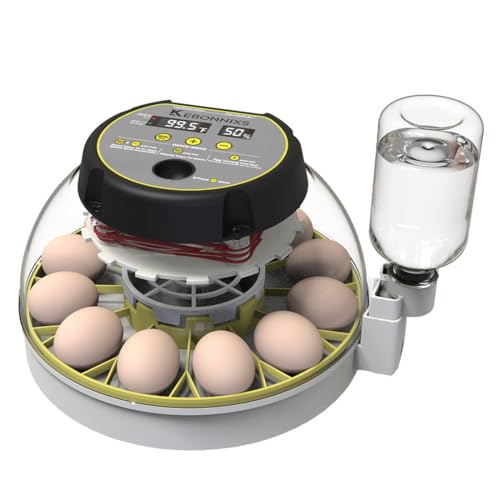
Stable Monitoring Pick – KEBONNIXS 12 Egg Incubator
This KEBONNIXS duck egg incubator focuses on the essentials: stable airflow, humidity display, automatic turning, and built-in candling. It is a straightforward choice if you want a compact incubator that helps you monitor conditions without adding extra accessories.
Best For: Users who want a simple 12-egg incubator with the core tools already built in.
Pros:
- Strong circulating fan supports stable temperature distribution.
- Humidity display removes the need for a separate hygrometer.
- Built-in egg candler helps observe egg development.
- Water can be added without opening the lid, reducing temperature fluctuation.
Cons:
- Designed for 12 eggs, so capacity is limited.
- Bullets describe chicken hatching specifically, even though the unit can be used for duck eggs.
As a duck egg incubator, this model is best suited to users who want dependable basic controls rather than advanced customization. Its easy-fill water design and auto-stop turning add convenience during the hatch cycle.
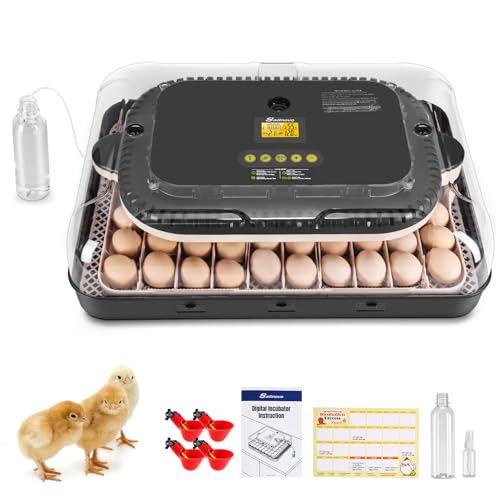
High-Capacity Smart Hatch – Sailnovo 70 Egg Smart Incubator
If you need a duck egg incubator for a larger batch, this Sailnovo unit is designed for volume, monitoring, and automation. It combines temperature presets, humidity management, automatic turning, and alerts in a 70-egg format that works well for schools, farms, or lab-style use.
Best For: Larger hatching projects that need space for multiple egg types and active condition monitoring.
Pros:
- Holds up to 70 eggs and includes adjustable trays for duck, goose, chicken, and quail eggs.
- Automatic turning every 2 hours stops 3 days before hatch.
- LED display shows temperature, humidity, incubation day, and turning status.
- Built-in candling and alert system help track conditions during incubation.
Cons:
- Larger footprint than a compact tabletop incubator.
- Advanced features may be more than casual users need.
For users who want a duck egg incubator with more capacity and stronger monitoring, this is the most scalable option in the group. The included styrofoam cover and alert system also make it more suitable for variable environments.
Beginner-Friendly Basic Hatch – Series I 12 Egg Incubator
This duck egg incubator is aimed at beginners who want a simpler, more guided hatch with essential automation. It offers automatic turning, steady humidity support, and consistent temperature control in a compact 12-egg design that is easy to set up and follow.
Best For: First-time hatchers who want an uncomplicated incubator with light automation and clear viewing.
Pros:
- Automatic egg turning every 2 hours supports even development.
- Self-regulating humidity uses a single water bottle for minimal adjustment.
- Real-time temperature display and clear lid make monitoring easy.
- Removable tray and components simplify cleanup after each hatch.
Cons:
- Temperature display is Fahrenheit only.
- Humidity is not presettable and may vary with ambient conditions.
This is a practical duck egg incubator for users who want the basics without a complex control system. It keeps the process approachable while still including the core functions needed for a small hatch.
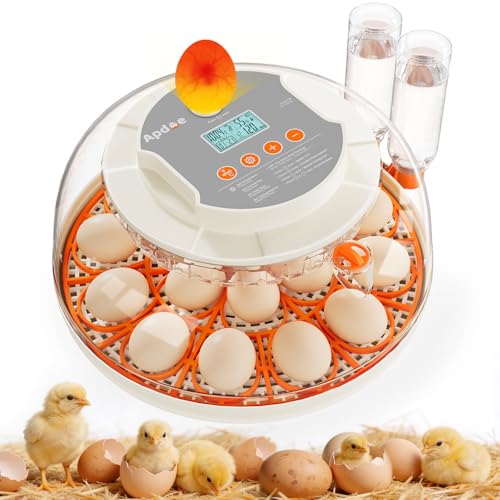
Premium 18-Egg Versatility – APDOE 18-Egg Incubator for Ducks and More
This duck egg incubator is built for users who want flexible control without constant hands-on work. It supports duck eggs with a dedicated larger tray, while also offering automatic turning, adjustable incubation timing, and humidity management for a wider range of poultry.
Best For: Hatching duck eggs plus mixed batches in home, farm, classroom, or lab settings.
Pros:
- Large tray holds up to 8 duck, goose, or turkey eggs.
- Automatic egg turning with 1h, 2h, or 3h intervals and lockdown stop.
- External water bottle helps maintain humidity with fewer refills.
- Built-in candler and 360° clear lid make monitoring easy.
Cons:
- Duck capacity is lower than the standard chicken-egg tray capacity.
- Advanced settings may take a little time to learn.
Overall, this is a practical duck egg incubator if you want more control over timing, monitoring, and humidity in one unit. The separate duck tray and adjustable cycle settings make it especially useful for users managing different egg types.
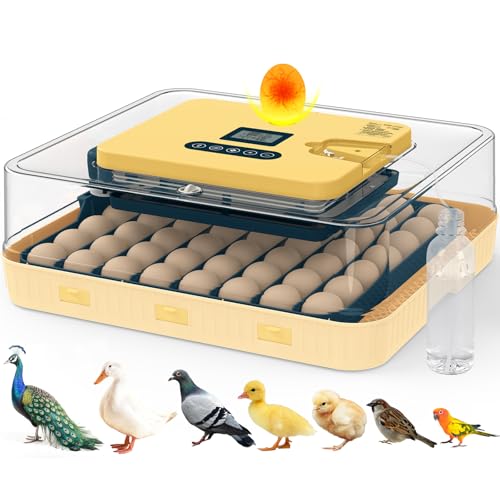
Large Batch Control – 56-Egg Incubator with Smart Alerts
If you need a duck egg incubator with room for larger batches, this 56-egg model focuses on automated control and visibility. It combines temperature and humidity management, automatic turning, and a 360° viewing design to help you track incubation with less guesswork.
Best For: Small farms, schools, and labs hatching duck eggs along with other poultry.
Pros:
- Holds up to 56 eggs and supports duck, chicken, quail, and other poultry.
- Automatic turning runs every 2 hours and stops 3 days before hatching.
- Smart alarm warns when temperature or humidity moves outside preset limits.
- 360° visual design and egg candler help monitor development.
Cons:
- Tip notes say to remove the egg tray on the 19th day.
- More features can mean more setup and monitoring than a basic unit.
This model is a strong pick if you want a duck egg incubator that emphasizes batch size and automated alerts. Its combination of turning, humidity control, and easy viewing makes it well suited to users who want more oversight during incubation.
Compact Smart Pick – 18-Egg Incubator with Auto Turning
This duck egg incubator keeps things compact while still offering core automation for everyday hatching. It includes temperature control, regulated humidity, customizable turning intervals, and a clear dome for watching egg development without opening the unit.
Best For: Home users and classrooms wanting a straightforward incubator for duck eggs and other small batches.
Pros:
- Supports 18 standard eggs such as chicken or duck.
- Turning can be set to 60, 120, or 180 minutes.
- Auto-turning pauses 96 hours before hatching for the final stage.
- LED candling light and 360° dome make inspection simple.
Cons:
- Overall capacity is limited compared with larger incubators.
- Best results depend on careful setup and following the manual.
For buyers who want a smaller duck egg incubator with practical automation, this model covers the essentials well. It offers enough control for everyday use while staying easy to inspect and manage during the hatch window.
Precision 12-Egg Controller – Compact 12-Egg Duck Egg Incubator
If you want a duck egg incubator with tighter control and a compact footprint, this 12-egg model is built around digital monitoring, automatic turning, and guided humidity management. It is designed for chicken, duck, goose, quail, and pigeon eggs, with a display that keeps temperature and humidity visible during the full hatch cycle.
Best For: Home users, classrooms, and hobby hatchers who want a compact, feature-rich incubator with automatic control.
Pros:
- 12-egg capacity with support for duck eggs and other small poultry eggs
- Digital display shows temperature, humidity, and incubation data in real time
- Automatic turning with selectable 60/120/180 minute intervals
- Built-in candling light and 360° airflow circulation for monitoring and stability
Cons:
- Best suited to small batches rather than larger hatches
- Humidity management depends on dual external water tanks and refill routine
- Compact size may be less convenient if you need a bigger tray layout
This is a practical pick if you want a small incubator that bundles the main hatch controls into one unit. The combination of automatic turn timing, stabilization tech, and viewing window makes it easy to track a duck hatch without constant guesswork.
Hands-Off Humidity Pick – Sailnovo 12-Egg Duck Egg Incubator
This duck egg incubator focuses on convenience, especially if you want to reduce the need to open the lid during incubation. It combines automatic humidification, temperature control, turning, and a built-in candler, making it a straightforward option for beginners and small farm use.
Best For: Beginners, school projects, and small farm users who want easy humidity management.
Pros:
- Integral humidity control motor helps keep conditions stable without opening the lid
- 360° viewing lets you observe the hatch from all angles
- Built-in egg candler supports embryo monitoring during incubation
- Automatic egg turning flips every 120 minutes and stops 4 days before hatching
Cons:
- 12-egg capacity keeps it in the small-batch category
- Humidity control is simple, but still requires routine water management
- Included accessories add convenience, though the unit is still a lightweight compact design
For buyers who care most about stable humidity and easy operation, this model keeps the basics well covered. Its automatic water management and clear digital readout make it an approachable choice for first-time duck egg incubation.
Easy-Clean Monitoring Choice – Grey 12-Egg Duck Egg Incubator
For shoppers looking for a duck egg incubator that emphasizes monitoring and easy maintenance, this 12-egg unit combines temperature and humidity control with automatic turning and a clear 360° view. It also includes external water refilling, so you can maintain conditions without disturbing the eggs as often.
Best For: Users who want simple setup, easy cleaning, and external water refill convenience.
Pros:
- Automatic turning with optional 60, 120, or 180 minute intervals
- External water fill helps maintain humidity without opening the incubator
- Built-in candling feature supports embryo checks during the hatch cycle
- 360° transparent design makes it easy to monitor and clean
Cons:
- 12-egg capacity limits how many duck eggs you can hatch at once
- Fewer advanced control details are listed than on some competing models
- Compact layout may not suit buyers needing a larger tray system
This is a solid all-around pick if you value visibility and easier upkeep over extra complexity. The external refill system and removable parts should appeal to anyone who wants a cleaner, lower-fuss incubation routine.
How We Picked These Duck Egg Incubators
We looked for incubators that support the needs of duck eggs, including stable temperature control, humidity management, automatic turning, and clear visibility during the hatch. We also favored models with useful extras such as built-in candlers, water access that is easy to manage, and alerts that help reduce guesswork.
Quick Comparison
Smaller-capacity units are a strong fit for first-time hatchers or small backyard flocks, while mid-size and larger models are better if you want to hatch multiple ducks at once or mix egg types. In general, the most convenient Duck Egg Incubator is one that keeps conditions steady without constant adjustment from you.
Key Buying Factors for a Duck Egg Incubator
Temperature Stability
Duck eggs need consistent heat throughout incubation. Look for a unit with dependable temperature control rather than one that simply claims a wide range. Fluctuations can hurt development, especially during the final days before hatch.
Humidity Control
Humidity matters more for ducks than many first-time buyers expect. A good incubator should make it easy to monitor and adjust moisture levels so the eggs lose water at the right pace. A display or alert system is helpful, but easy refilling is just as important.
Automatic Turning
Turning helps keep embryos developing properly during the early and middle stages. Automatic turning is a major convenience feature, and it is especially valuable if you are incubating multiple eggs or cannot check them several times a day.
Capacity and Visibility
Choose a size that matches your flock goals. A compact Duck Egg Incubator is ideal for beginners, while larger units make sense for repeat hatches. Clear viewing windows can help you monitor progress without opening the lid too often.
Who Should Buy Which Duck Egg Incubator?
Beginners should focus on simple controls, automatic turning, and readable humidity and temperature displays. If you want to hatch duck eggs alongside chickens or other poultry, choose a model with enough capacity and flexible settings. For higher-volume users, look for a larger incubator with strong visibility, reliable alerts, and low-maintenance humidity support.
In short, the best choice is the incubator that matches your experience level, batch size, and how much hands-on monitoring you’re comfortable doing.